Cost
Micro Economics
Sem I
- Cost refers to the expenditure on the production of a commodity.
- Short run costs are those costs when some factors of production are fixed.
- Long run costs are those costs when all the factors of production are variable.
Tip
Total Cost = Fixed Cost + Variable Cost
Basics of Cost
Fixed Cost
TipFixed Cost
Fixed Cost refers to the expenditure incurred by the producer on the use of fixed factors of production.
It is also known as supplementary cost or overhead costs. These costs are independent of output, i.e., they do not change with changes in output.
Examples of Fixed Cost
- Contractual rent, insurance fee, maintenance costs, property taxes, interest on the capital invested etc.
We can understand this with the help of following table
| Units of Output | Total Fixed Cost |
|---|---|
| 0 | 10 |
| 1 | 10 |
| 2 | 10 |
| 3 | 10 |
| 4 | 10 |
| 5 | 10 |
| 6 | 10 |
Variable Cost
TipVariable Cost
Variable Cost refers to the expenditure incurred by the producer on the use of variable factors of production.
It is also known as price costs or direct costs. In short run variable costs increases or decreases when the output rises or falls.
Examples of Variable Cost
- Wages of labour employed, prices of the raw materials, fuel and power used, transportation cost etc.
We can understand variable cost with the help of following table:
| Units of Output | Variable Cost |
|---|---|
| 0 | 0 |
| 1 | 10 |
| 2 | 18 |
| 3 | 24 |
| 4 | 28 |
| 5 | 32 |
| 6 | 38 |
Difference between Fixed Cost and Variable Costs
| Fixed Costs | Variable Costs |
|---|---|
| Fixed costs are the costs incurred on the fixed factors of production. | Variable Costs are those costs incurred on the variable factors of production |
| Fixed costs do not change with increase or decrease in output. | Variable costs increase with increase in output, and decrease with decrease in output |
| Fixed cost remains constant even when output is zero. | Variable costs are zero when output is zero. |
| Fixed costs are incurred even before production actually starts. | Variable costs are incurred only when production actually starts. |
Total Cost
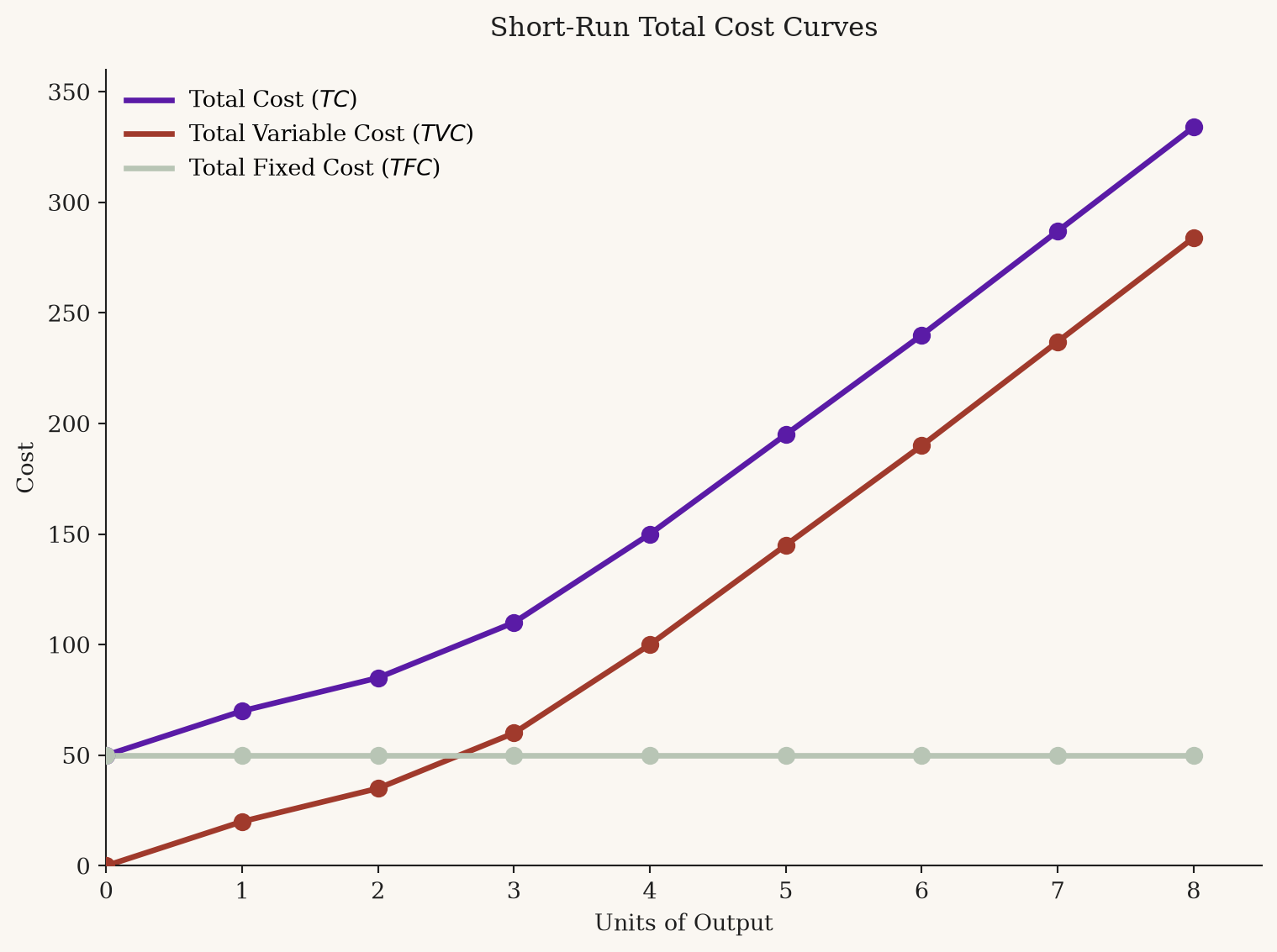
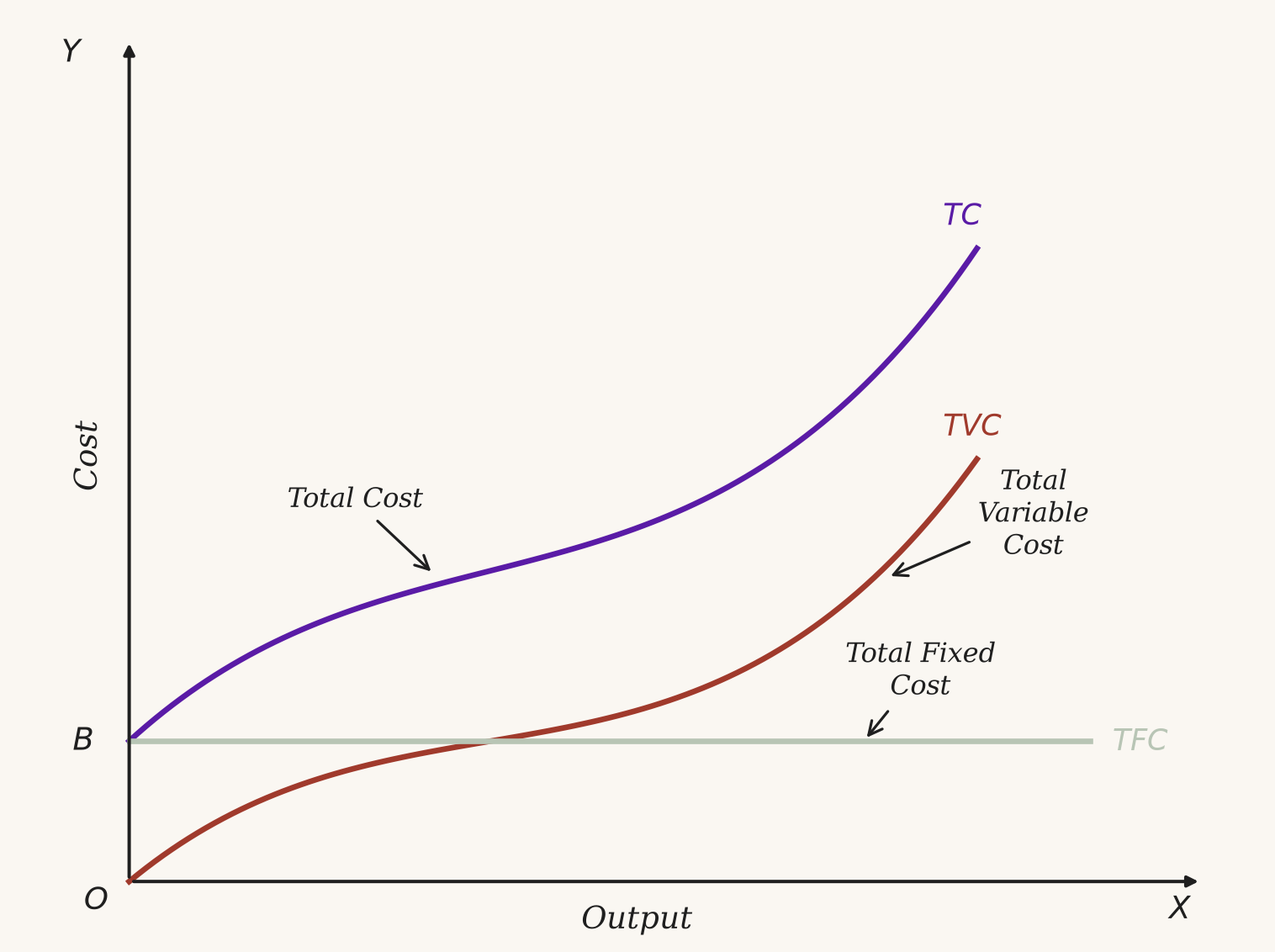
Total Costs is the sum of its total variable costs and total fixed cost. i.e., TC = TFC + TVC. As one component, i.e., the total variable cost (TVC) varies with the change in output, the total cost of production (TC) will also change with the changes in the level of output. The total cost increases as the level of output rises.
We can understand this with the help of following table:
| Units of Output | Total Fixed Cost | Total Variable Cost | Total Cost |
|---|---|---|---|
| 0 | 50 | 0 | 50 |
| 1 | 50 | 20 | 70 |
| 2 | 50 | 35 | 85 |
| 3 | 50 | 60 | 110 |
| 4 | 50 | 100 | 150 |
| 5 | 50 | 145 | 195 |
| 6 | 50 | 190 | 240 |
| 7 | 50 | 237 | 287 |
| 8 | 50 | 284 | 334 |
Marginal Cost
It is an addition to the total cost when an additional unit of output is produced. In other words, marginal cost is the addition to the total cost of producing n units instead of n – 1 units (i.e., one less) where n is any given number. Symbolically,
\[MC_n=TC_n-TC_{n-1}\] It can also be represented as: \[MC=\frac{\Delta TC}{\Delta Q}\] We can understand this with the help of following table:
| Output \((Q)\) | Total Cost \((TC)\) | Marginal Cost \((MC)\) |
|---|---|---|
| 0 | 100 | - |
| 1 | 125 | 25 |
| 2 | 145 | 20 |
| 3 | 160 | 15 |
| 4 | 180 | 20 |
| 5 | 206 | 26 |
| 6 | 236 | 30 |
| 7 | 273 | 37 |
Average Cost
Cost per unit of output produced is called average cost. It is also called unit cost of production.
\[AC=\frac{TC}{Q}\] Since, \[TC = TFC + TVC\] So, \[AC=\frac{TFC+TVC}{Q}\] \[AC=\frac{TFC}{Q}+\frac{TVC}{Q}\] \[AC=AFC+AVC\]
Average Fixed Cost
Average Fixed Cost is the Total Fixed Cost per unit of output. \[AFC=\frac{TFC}{Q}\] We can understand this with the help of following table:
| Output | Total Fixed Cost | Average Fixed Cost |
|---|---|---|
| 1 | 10 | 10 |
| 2 | 10 | 5 |
| 3 | 10 | 3.3 |
| 4 | 10 | 2.5 |
| 5 | 10 | 2 |
| 6 | 10 | 1.67 |
| 7 | 10 | 1.43 |
| 8 | 10 | 1.25 |
AFC cannot be zero, as it takes the shape of Rectangular Hyperbola
Average Variable Cost
Average Variable Cost is the Total Variable Cost per unit of output. \[AVC=\frac{TVC}{Q}\] We can understand this with the help of following table:
| Output | Total Variable Cost | Average Variable Cost |
|---|---|---|
| 1 | 10 | 10 |
| 2 | 18 | 9 |
| 3 | 24 | 8 |
| 4 | 28 | 7 |
| 5 | 32 | 6.4 |
| 6 | 38 | 6.3 |
| 7 | 46 | 6.6 |
| 8 | 62 | 7.7 |